The Korean way to rest: warm floors, jjimjilbang, barley tea and temple quiet
One of the first things visitors notice in Korea is the floor. In restaurants, in friends’ homes, in jjimjilbang, people sit and lie on it. To understand how Koreans rest, you have to start there.
Ondol: a house warmed from below
Ondol is the traditional Korean way of heating a room through its floor. In older houses, a fire in the kitchen stove sent hot air through channels beneath thick stone slabs, warming the floor above. Today most Korean apartments do the same job with hot-water pipes under the floor.
When the floor is the warmest place in the house, life moves down to it. People sit on it, eat on it and rest on it. Many Koreans have childhood memories of winter afternoons lying on the hottest spot of the floor; there is even a phrase for it, roughly “warming your back”.
Jjimjilbang: resting together
A jjimjilbang is a bathhouse with extra floors of heated rooms and big communal halls. After bathing, everyone changes into the same loose outfit, rolls a towel into a little “sheep’s head” hat, and lies around on the warm floor eating baked eggs and drinking sikhye, a sweet rice drink. Families go, friends go, people go alone.
It’s a very sociable kind of rest — and it’s a little remarkable how comfortable people are lying down among strangers.
Tea: grains and fruit, not just leaves
In many Korean restaurants, the water on the table is actually barley tea, made from roasted barley and served warm or cold. At home people brew corn tea or cassia seed tea, and in winter they drink jujube tea simmered for hours, or yuja tea made from citron preserve.
If you think of tea only as leaves, Korean tea can be a surprise. Grain and fruit teas are far more everyday, and their gentle taste suits resting well.
Templestay: the quiet of a mountain temple
Since 2002, many Korean Buddhist temples have opened their doors through the Templestay programme, letting visitors share temple life for a day or more: early-morning chanting, formal monastic meals, 108 prostrations and tea with a monk. What stays with you is often the simplest part — the silence.
Trying it in the city
All of these share the same instinct: get low, get warm, get quiet. RESTEL tries to bring that instinct into a small space in Seoul.
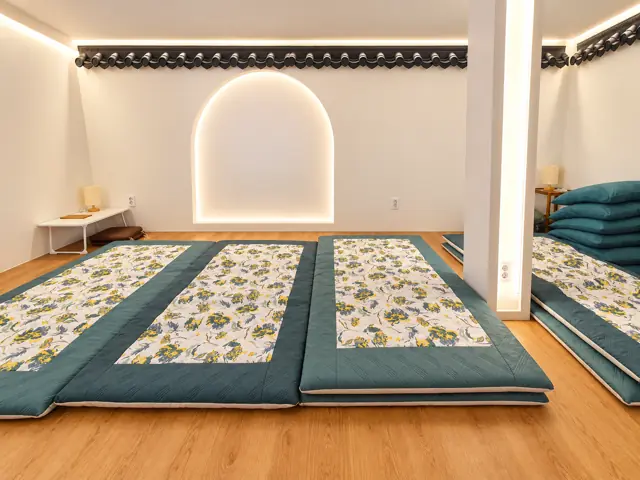
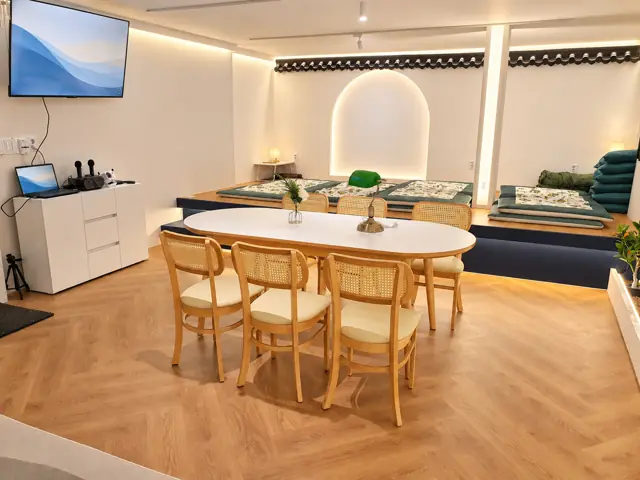
At RESTEL Sinchon you take your shoes off and step up onto a raised wooden platform. There are buckwheat pillows, folding mats and blankets, and in the tea corner, jujube, barley and brown-rice green tea. Guided meditation plays through the room’s speakers, so you don’t need earphones.
For travellers we put together K-REST 90. It begins with a cup of tea, moves into guided breathing, and ends with rest on a warm floor — about 90 minutes in all. If you’ve ever wanted to understand the Korean way to rest rather than just read about it, this is a gentle way in.
Questions
Are ondol and jjimjilbang the same thing?
How can I experience Korean-style rest on a short trip?
Why do Koreans sit and sleep on the floor?
Try the Korean way to rest
Tea, guided breathing and a warm floor, in 90 minutes and in your language.
RESTEL is a rest space rental, not an accommodation.